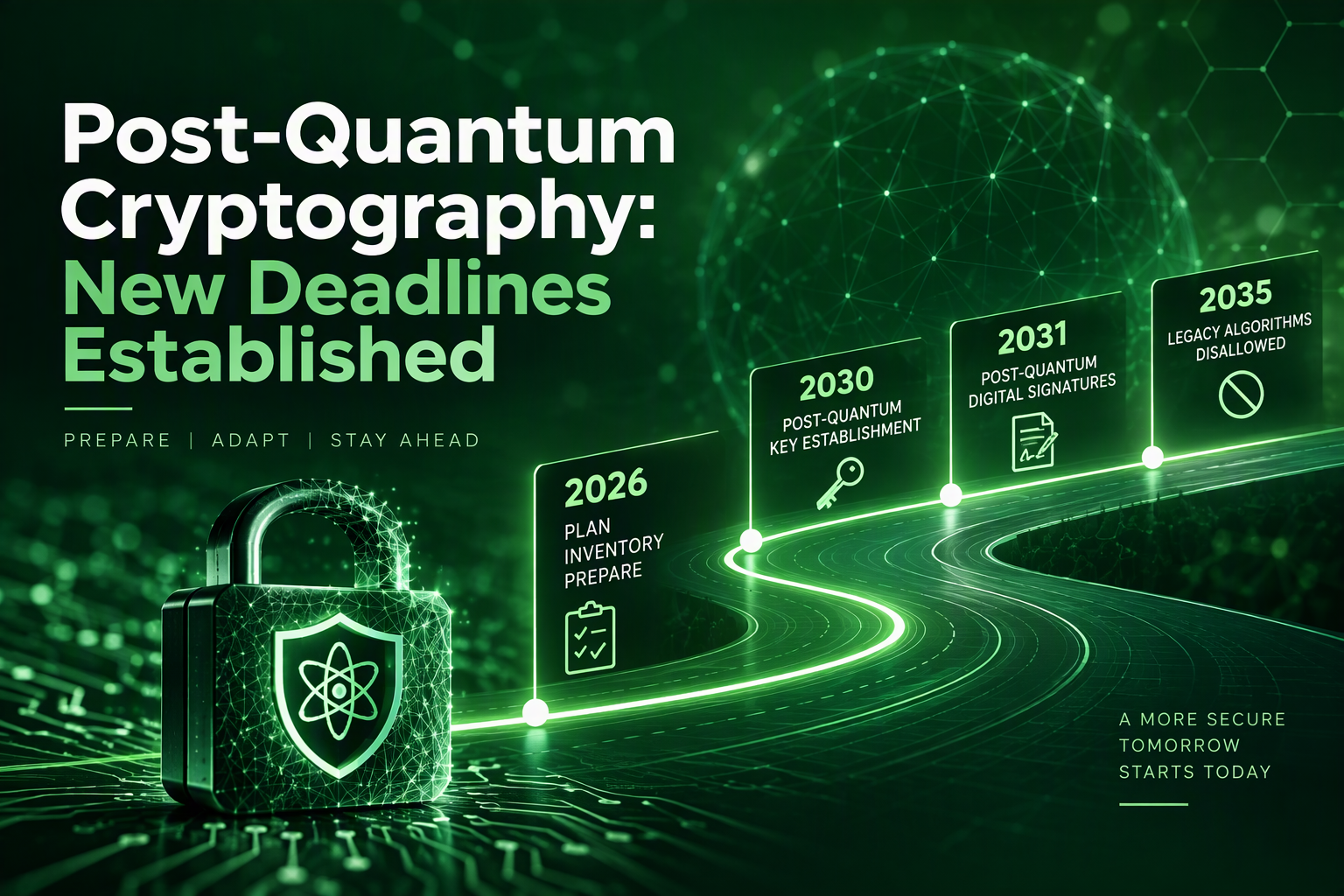
For years, the transition to Post-Quantum Cryptography (PQC) has been discussed as a future challenge. With the recent publication of NIST IR 8547, Transition to Post-Quantum Cryptography Standards, that conversation has changed.
NIST has now established a clear roadmap for moving away from quantum-vulnerable public-key cryptography, including deadlines for when widely used algorithms will be deprecated and ultimately disallowed under NIST standards and guidelines. For technology vendors, particularly those serving the federal government and security-sensitive markets, PQC is becoming a product roadmap and certification issue.
The Dates Vendors Need to Know
NIST’s overall target for completing the federal transition to PQC remains to be 2035, but focusing only on 2035 overlooks several much closer milestones. Under Executive Order 14412 and OMB Memorandum M-26-15, federal high-value assets, high-impact systems, and certain other sensitive systems must transition to:
- Post-quantum key establishment by December 31, 2030
- Post-quantum digital signatures by December 31, 2031
NIST plans to deprecate quantum-vulnerable public-key cryptography after 2030 and disallow its use under NIST standards and guidelines after 2035, which includes:
- RSA,
- ECDSA and EdDSA digital signatures, and
- RSA-, finite-field- and elliptic-curve-based key establishment.
Under NIST terminology, “deprecated” means an algorithm may still be used, but its security risk must be evaluated and accepted. “Disallowed” means it is no longer permitted for the stated purpose.
Federal agencies are also required to support TLS 1.3 by January 2, 2030, with NIST identifying TLS as an early PQC migration priority. Additionally, there is also a security threat which could motivate vendors to act sooner – “harvest now, decrypt later“. Adversaries can collect encrypted data today, intending to decrypt it once sufficiently later when capable quantum technology becomes available. Systems protecting information that must remain confidential for many years therefore have reason to transition earlier.
What Is Replacing Today’s Algorithms?
NIST has already standardized the principal building blocks:
- FIPS 203: ML-KEM for post-quantum key establishment
- FIPS 204: ML-DSA for post-quantum digital signatures
- FIPS 205: SLH-DSA as another post-quantum digital signature standard
For key establishment, NIST currently recommends ML-KEM-768 as the default parameter set.
However, not everything needs replacement. NIST states that approved symmetric cryptography providing at least 128 bits of classical security is significantly less vulnerable to known quantum attacks, meaning algorithms such as AES-128, AES-192 and AES-256 remain part of the landscape.
What This Means For Vendors Evaluating FIPS 140-3
For vendors with FIPS 140-3 validation goals, PQC should become part of product and validation roadmap discussions now.
Software cryptographic libraries, hardware cryptographic modules, HSMs, TPMs, PKI infrastructure and the applications and protocols that depend on them may all need to evolve to support PQC. NIST specifically highlights the long development cycles associated with cryptographic hardware and identifies immediate PQC integration as a high priority for hardware vendors.
What Product Vendors Should Do Now
The immediate priority is not simply “implement PQC.” It is understanding where cryptography exists throughout the product and its dependencies.
NIST explicitly calls for organizations to begin with cryptographic inventories, migration planning, and early deployments of PQC-enabled products and services.
For product leaders, that means asking:
- Where do RSA, ECC, Diffie-Hellman and other quantum-vulnerable algorithms exist today?
- Which products serve customers facing the accelerated 2030/2031 federal deadlines?
- Which libraries, hardware, PKI systems and external dependencies must change first?
- How will ML-KEM, ML-DSA and SLH-DSA affect product architecture and FIPS 140-3 validation plans?
- Is the product sufficiently crypto-agile to accommodate this transition and future algorithm changes?
The Transition Starts Now
The critical takeaway from NIST IR 8547 is not that today’s cryptography disappears tomorrow. It is that the transition now has a defined timeline, and vendors serving sensitive federal environments face milestones well before 2035.
Waiting until customers make PQC support an explicit requirement could leave significantly less room for architectural changes, testing, interoperability work and FIPS 140-3 validation planning.
A focused cryptographic and FIPS assessments can help vendors understand their current exposure, identify dependencies and develop a realistic transition roadmap. Corsec can help organizations evaluate that landscape and build a PQC and FIPS strategy aligned with their products, customers and certification objectives.
The deadline may say 2030 or 2035. For product planning, the transition starts now.
About Corsec Security, Inc.
For over 28 years, Corsec has assisted companies through the IT security certification process for FIPS 140-2 / FIPS 140-3, Common Criteria (CC), CSfC, and DoD STIG / DoDIN APL. We are a privately owned company focused on partnering with organizations worldwide to assist with the process of security certifications and validations. Our certification methodology helps open doors to new markets and increase revenue for clients with products ranging from mobile phones to satellites. Our broad knowledge safeguards against common pitfalls and thwarts delays, translating to a swift and seamless path to certification. Corsec has created the benchmark for providing business leaders with fast, flexible access to industry knowledge on security certifications and validations.
###
Connect With Us:
Stay up to date with Corsec as we bring you all the most recent updates to the standards, certifications, and requirements – Subscribe

Press Contact:
Jake Nelson
Corsec Director of Marketing
jnelson@corsec.com