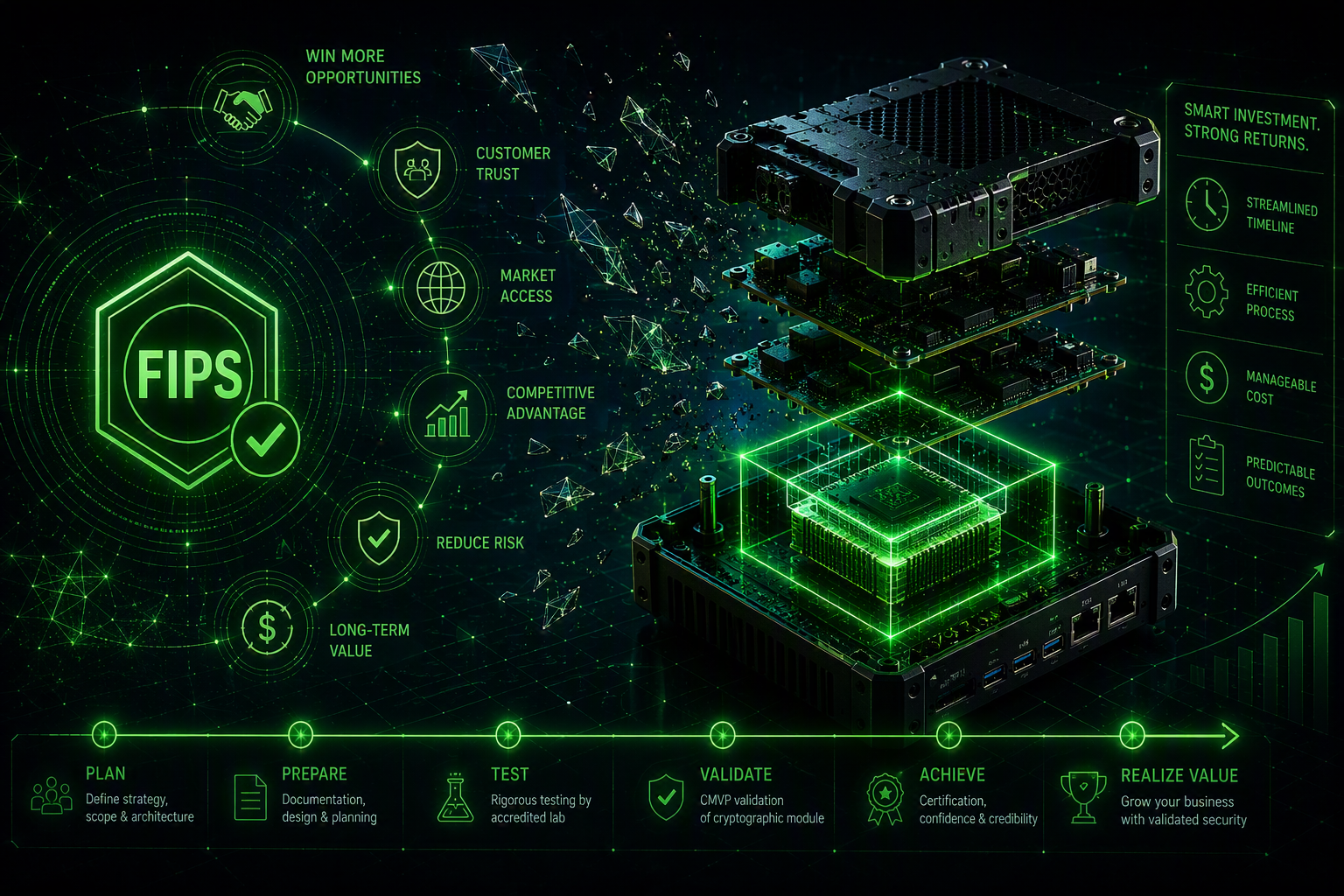
When organizations evaluate FIPS 140-3 validation, the conversation often begins with cost and timeline. Certification requires planning, engineering effort, testing, and coordination with the Cryptographic Module Validation Program (CMVP), making it easy to view validation primarily as a compliance expense.
Given these requirements, it is understandable that organizations question whether the investment is justified, particularly when product teams are focused on accelerating releases, entering new markets, and meeting customer demands.
However, that perspective overlooks a more important consideration: the business value that validation can create. For organizations that sell into federal, defense, critical infrastructure, and other regulated markets, validation can open new markets, strengthen product security, reduce compliance friction, and enhance competitive positioning.
This post is the fifth and final installment in our Deconstructing FIPS 140-3: 5 Myths and Realities series, where we examine common misconceptions surrounding FIPS 140-3 and what organizations should understand before beginning the validation process.
Myth #5: “The Cost and Timeline of FIPS Validation Aren’t Justified.”
FIPS 140-3 validation requires an investment of time, resources, and budget. For some organizations, those costs can appear difficult to justify, especially when viewed only as a compliance requirement.
However, the more important question is “What is the cost of not addressing FIPS 140-3”
Reality: Validation Is an Investment in Market Access, Product Readiness, and Risk Reduction
FIPS 140-3 validation is not simply an administrative exercise. It provides independent assurance that a cryptographic module has been evaluated against the CMVP’s security requirements. For organizations selling into government and regulated environments, the absence of a validation can result in:
- Exclusion from certain solicitations or procurement opportunities
- Delayed customer deployments
- Restrictions on where a product can be deployed
- Lost opportunities to competition
- Repeated customer-specific security reviews
- Delayed entry into new government or regulated markets
When viewed through this lens, the investment in validation should be weighed against the opportunities it enables and the risks it helps mitigate.
Understanding the Real Timeline Risk
Another common misconception is that all FIPS validations require the same level of effort and follow the same path to validation.
In reality, organizations have several options depending on their product architecture, business objectives, and deployment requirements. These may include:
- Full FIPS 140-3 validation
- Private-labeling or Rebrands
- Cryptographic Algorithm Validation Program (CAVP) testing
- Entropy Source Validation (ESV)
Not all approaches are equal in scope, complexity, cost, or timeline.
Organizations sometimes postpone validation activities because they want to avoid investing resources before a customer explicitly requires FIPS validation. However, when FIPS requirements emerge late in the product lifecycle, engineering teams may need to revisit architectural decisions, modify cryptographic implementations, restructure documentation, or develop a separate product configuration for validation. These changes can disrupt development schedules that were never designed around certification requirements.
The result is often not only a larger validation budget, but a significantly larger product development budget. By evaluating validation options and requirements early, organizations can make more informed design decisions, minimize rework, and avoid costly schedule impacts later in the product lifecycle.
The Real Business Case for FIPS 140-3
The value of FIPS 140-3 extends far beyond the initial certification expense. A validated cryptographic module can support multiple customer engagements, procurement opportunities, and deployments without requiring organizations to repeatedly demonstrate cryptographic compliance from scratch.
For organizations targeting federal, defense, critical infrastructure, and other regulated markets, validation is often a prerequisite for doing business. In many cases, the question is not whether validation costs time and money, but whether the market access, revenue opportunities, and competitive advantages it enables justify the investment.
Organizations can also make the cost and timeline of FIPS 140-3 more predictable through early planning. Defining the validation scope, establishing the cryptographic boundary, identifying required algorithm validations, conducting readiness assessments, and integrating validation activities into the product roadmap can reduce rework, minimize delays, and improve project outcomes.
As FIPS 140-2 continues its transition out of active validation status, organizations developing new products should evaluate their long-term FIPS 140-3 strategy now rather than later. The earlier validation requirements are considered during product development, the easier it becomes to align certification objectives with engineering, business, and go-to-market goals.
A Strategic Approach to Validation
FIPS 140-3 validation requires time, resources, and investment. However, early planning can make the process more predictable and reduce costly surprises.
By incorporating validation into product development from the beginning, organizations can identify gaps earlier, minimize rework, better manage timelines, and align certification efforts with business objectives.
Ultimately, the right question is not simply, “How much will FIPS 140-3 cost?” but “What value will validation create for our product and market?”
For organizations that need FIPS validation to compete, the cost of not being validated may be significantly greater than the cost of validation itself.